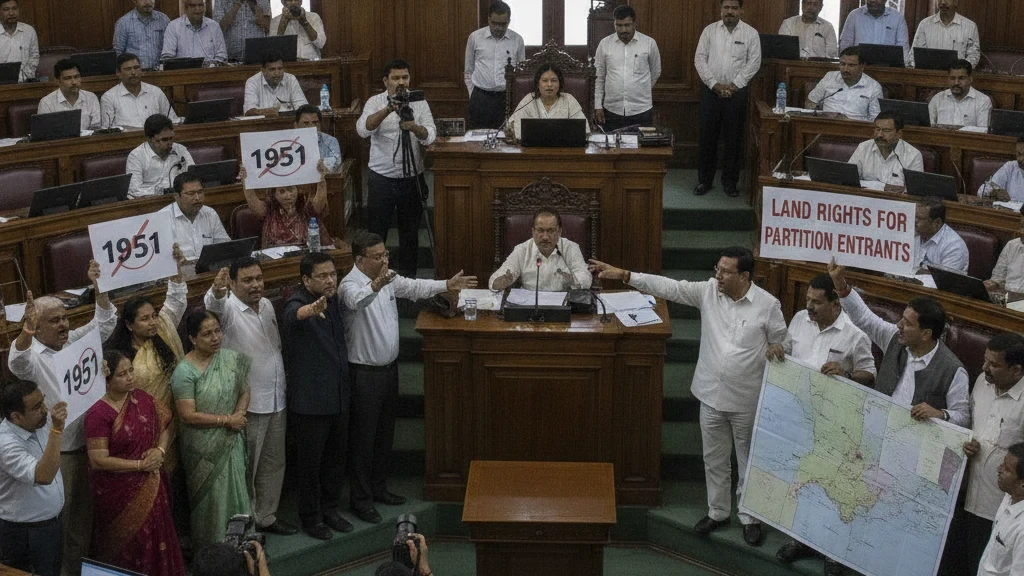
Guwahati: The Assam Legislative Assembly was the scene of intense discussions this week, primarily revolving around the contentious issue of the cut-off year for identifying and potentially deporting foreigners from the state. A significant divergence emerged between the ruling coalition and opposition members on whether to adopt 1951 or 1971 as the definitive year.
Members of the ruling coalition advocated for 1951 as the cut-off year, aligning their stance with practices observed in other parts of the country for such determinations. Conversely, opposition members, predominantly from the Congress party, expressed a preference for 1971. However, they indicated conditional support for the 1951 cut-off, provided the government furnishes crucial legacy data for districts where the 1951 National Register of Citizens (NRC) is unavailable, and for the six districts where the NRC was not prepared at all.
Adding another layer to the legislative proceedings, BJP legislator Kamalakshya Dey Purkayastha moved a resolution concerning land rights in the Barak Valley. The resolution specifically demanded that a section of people in the region, who had entered India during the Partition of British India, should be granted land pattas for properties they currently occupy. This proposal seeks to apply provisions under the Enemy Property Act, 1968.
The Enemy Property Act, enacted by Parliament following the 1965 Indo-Pakistan war, is designed to enable and regulate the appropriation of property in India owned by Pakistani nationals. Reports indicate that several individuals from erstwhile East Bengal have been residing on approximately 7,690 bighas of land that fall under the purview of this complex legal framework, making the resolution a critical step towards addressing long-standing land tenure issues for these communities.
Continue Reading