Finance Minister highlighted that over 350 reforms have been rolled out since the Prime Minister’s Independence Day address in 2025, including GST simplification
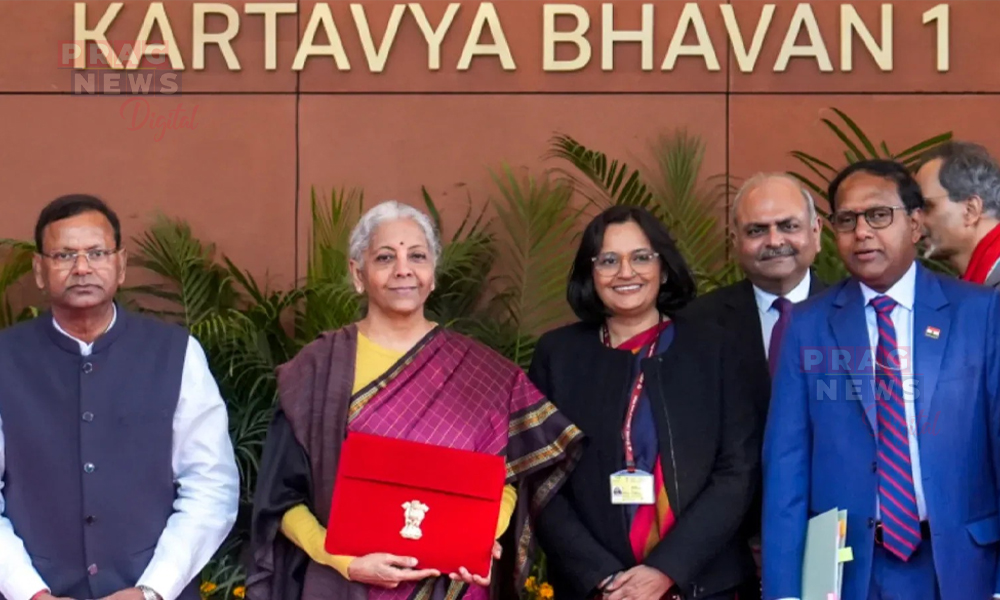
Digital Desk: On 1st February, Union Minister Nirmala Sitharaman presented the Union Budget 2026–27 in Parliament, outlining a wide-ranging roadmap focused on economic growth, capacity building and inclusive development. Presented on the auspicious occasion of Magha Purnima and the birth anniversary of Guru Ravidas, the Budget is the first to be prepared in Kartavya Bhawan and is guided by what the Finance Minister described as 3 core “Kartavya”.
The first Kartavya focuses on accelerating and sustaining economic growth by enhancing productivity, improving competitiveness and building resilience against volatile global dynamics. The second Kartavya aims to fulfil the aspirations of people and strengthen their capabilities, making them active partners in India’s journey towards prosperity. The third Kartavya, aligned with the vision of Sabka Saath, Sabka Vikas, seeks to ensure that every family, community, region and sector has equitable access to resources, opportunities and amenities.
Presenting what she termed a “Yuva Shakti-driven Budget”, Sitharaman said the government remains committed to its Sankalp of focusing on the poor, underprivileged and disadvantaged, while taking confident steps towards a Viksit Bharat. She noted that India must remain deeply integrated with global markets, even as global trade and supply chains face disruptions and technological shifts increase pressure on resources such as water, energy and critical minerals.
The Finance Minister highlighted that over 350 reforms have been rolled out since the Prime Minister’s Independence Day address in 2025, including GST simplification, labour code notifications and rationalisation of quality control orders. These reforms, she said, are being complemented by coordinated efforts with state governments to reduce compliance burdens and deregulate key sectors.
Under the first Kartavya, the Budget proposes interventions across six areas, including scaling up manufacturing in seven strategic sectors, rejuvenating legacy industries, creating champion MSMEs, strengthening infrastructure, ensuring long-term energy security and developing city economic regions. Public capital expenditure has been proposed to be increased to ₹12.2 lakh crore in FY 2026–27, up from ₹11.2 lakh crore in the previous year.
On infrastructure, the government announced seven high-speed rail corridors to act as growth connectors, new dedicated freight corridors, and the operationalisation of 20 national waterways over the next five years. City Economic Regions will receive ₹5,000 crore each over five years through a reform-linked financing mechanism.
Under the second Kartavya of capacity building, the Budget proposed establishing five regional medical hubs to promote medical tourism, scaling up veterinary education, setting up AVGC content creator labs in schools and colleges, and building one girls’ hostel in every district to support women in STEM education. A National Institute of Hospitality and a pilot scheme to upskill 10,000 tourist guides were also announced. The launch of a Khelo India Mission aims to transform India’s sports ecosystem over the next decade.
The third Kartavya focuses on inclusive development, with targeted initiatives for farmers, women, Divyangjan and the Northeast. Key announcements include the Bharat-VISTAAR multilingual AI platform for agriculture, SHE Marts under the Lakhpati Didi programme, the setting up of NIMHANS-2, and upgrading mental health institutes in Ranchi and Tezpur. The Budget also proposed developing an East Coast Industrial Corridor, creating five tourism destinations in the Purvodaya states, deploying 4,000 electric buses, and launching a Buddhist Circuit development scheme across six northeastern states.
Overall, the Union Budget 2026–27 seeks to balance ambition with inclusion, combining structural reforms, infrastructure push and social sector investments to steer India towards sustained and equitable growth.
Continue Reading