The Visible Emission Line Coronagraph, or VELC, is the largest and most difficult payload aboard Aditya-L1...
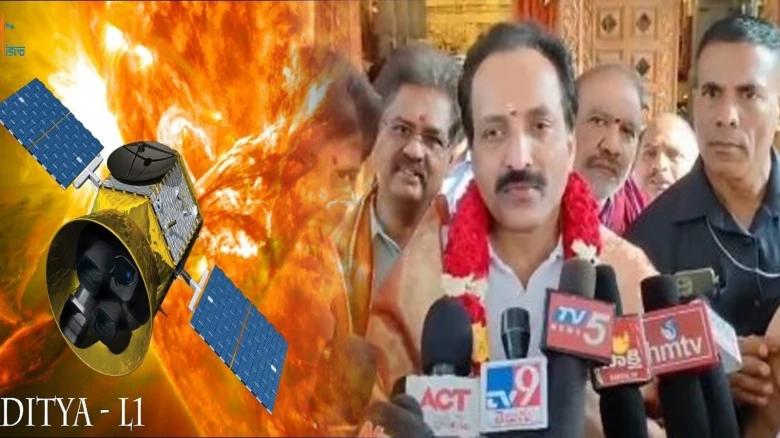
Digital Desk: The Indian Space Research Organization (ISRO) chief S Somanath said that the launch of India's first solar mission, Aditya-L1, is significant and that it will take 125 days to reach the L1 point.
Ahead of the launch of the Aditya-L1 Mission, India's first solar mission, on September 2 at 11.50 am from the Sriharikota spaceport in Andhra Pradesh, Somanath offered prayers at Chengalamma Parameshwari Temple in Tirupati district.
While talking to reporters, Somanath said, "Today the countdown of Aditya L1 is starting and it will launch tomorrow around 11.50 am. Aditya L1 satellite is for studying our Sun. It will take another 125 days to reach the L1 point. This is a very important launch. We have not yet decided (Chandrayaan-4), but we will announce it soon. After Aditya L1, our next launch is Gaganyaan, it will take place by the first week of October.”
The PSLV-C57 will launch Aditya-L1, India's first solar space observatory. Seven distinct payloads, including four that will observe the sun's light and three that will measure in-situ plasma and magnetic field parameters, will be carried on board to conduct a thorough study of the sun.
The Visible Emission Line Coronagraph, or VELC, is the largest and most difficult payload aboard Aditya-L1. In cooperation with ISRO, VELC was integrated, tested, and calibrated at the Hosakote CREST (Centre for Research and Education in Science Technology) site of the Indian Institute of Astrophysics.
Lagrangian Point 1 (L1), which is 1.5 million kilometres from the Earth in the direction of the sun, will be the object of Aditya-L1's halo orbit. The anticipated time for completion is four months.
Aditya-L1 will be able to constantly watch the sun from this advantageous position without being constrained by eclipses or occultation, enabling researchers to track solar activity and its effects on space weather in real-time. The data from the spacecraft will also contribute to a fuller understanding of space weather factors and help pinpoint the series of processes that lead to solar eruptive events.
The study of the physics of the solar corona and its heating mechanism, the acceleration of the solar wind, the coupling and dynamics of the solar atmosphere, the distribution and temperature anisotropy of the solar wind, and the origin of CMEs, flares, and near-Earth space weather are some of the main goals of India's solar mission.

Continue Reading