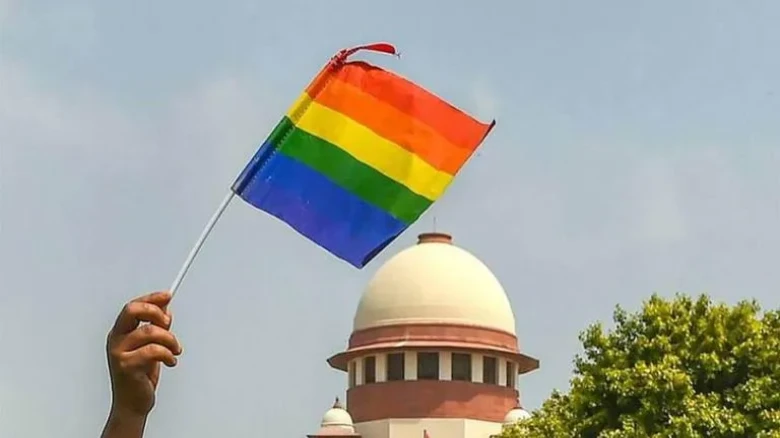
The Supreme Court reserved its judgement on a group of petitions seeking legal recognition for same-sex marriage on Thursday...
Digital Desk: The Supreme Court reserved its judgement on a group of petitions seeking legal recognition for same-sex marriage on Thursday. After a 10-day hearing, a five-judge Constitution bench led by Chief Justice D Y Chandrachud reserved its judgement.
The bench, which also included Justices S K Kaul, S R Bhat, Hima Kohli, and P S Narasimha, heard the rebuttal arguments advanced by senior advocates, including A M Singhvi, Raju Ramachandran, K V Viswanathan, Anand Grover, and Saurabh Kirpal, who represented the petitioners.
During the hearing on Wednesday, the Centre informed the Supreme Court that any constitutional pronouncement it makes on pleas seeking legal validity for same-sex marriage may not be the "correct course of action" since the court will not be able to foresee, envision, comprehend, and deal with the consequences.
The bench had noted that everyone was assuming the declaration would take the form of a writ.
"We are all assuming that the pronouncement will be in the type of a writ that grants this or grants that. This is what we're used to. What I was implying was that as a constitutional court, we acknowledge only a state of affairs and draw the line there...," Justice Bhat stated.
The Centre further told the court that it had received proposals from seven states on the matter of same-sex marriage, and the governments of Rajasthan, Andhra Pradesh, and Assam had opposed the petitioners' contention seeking legal validity for such nuptials.
Continue Reading